
Releasing the Weight of the World: How to Let Go of Over-Responsibility
Have you ever found yourself apologising for things you didn’t do, losing sleep over a colleague’s bad mood, or taking on the emotional heavy lifting in your relationships?
If this sounds familiar, you may be carrying an unhealthy level of responsibility for others and their outcomes. While caring deeply is a beautiful trait, over-responsibility can lead to exhaustion, resentment, and a loss of your own identity.
In this post, we will explore what it means to carry too much responsibility, the hidden beliefs that drive it, where these patterns come from, and how to scale it back to a healthy, sustainable level.
What is Over-Responsibility?
Over-responsibility occurs when you take on the emotional, practical, or situational burdens of other people as if they were your own. You begin to believe that it is up to you to fix problems, manage other people's feelings, and ensure positive outcomes.
It is vital to understand the difference between being responsible to someone (showing up with care, respect, and appropriate boundaries) and being responsible for someone (trying to control or fix their life choices, feelings, or results).
The hidden beliefs driving Over-Responsibility
Underneath these patterns are deep-seated self-beliefs that compel you to step in. You might find yourself operating under internal "rules" such as:
"If I can, I should": The assumption that simply possessing the capability to help means you are obligated to do so, regardless of the personal cost or whether it's actually your place.
"I am the only one they can rely on": A belief that others are incapable or fragile, leading you to take control because you fear things will fall apart if you don't.
"If I don’t do this, then others will be unhappy with me or I have failed": The belief that your worth is tied to keeping everyone around you happy. This causes you to project other people’s emotions as personal failures.
Signs you are carrying too much:
Offering unsolicited advice: You feel a constant urge to "fix" things instead of just listening.
Guilt when saying "no": Setting a simple boundary feels like a betrayal.
Absorbing moods: If a partner or friend is having a bad day, you feel it's your job to change it.
Over-functioning: You do things for others that they are perfectly capable of doing for themselves.
Over-responsibility is often driven by a desire to feel safe or to avoid conflict, rather than a desire to control others.
Where does Over-Responsibility come from?
These patterns don't appear out of nowhere; they are typically coping mechanisms developed earlier in life.
Fear of Failure: The belief that if an outcome is less than perfect, it reflects your own competence. To avoid feeling inadequate, you take complete control.
Family Roles: If you grew up as a "young carer," a mediator between parents, or looked after siblings, you learned that your safety relied on managing the environment.
Fear of Rejection: You may believe that if you aren't constantly "useful," people will leave you.
Perfectionism: An internal drive to prevent any perceived "disaster" by overseeing every detail.
How to scale back to a healthy level?
Learning to let go takes time. You can begin shifting your mindset with these actionable steps:
1. The "Pie of Responsibility"
When a situation goes wrong, or you feel the weight of an outcome, visualize the responsibility as a 100% circle—a pie. When we are over-responsible, we tend to grab the whole pie for ourselves. To reduce this, you must consciously allocate segments to other contributing factors:
Your Segment: Only the things you actually said or did (e.g., 10%).
The other person/s segment: Their personality, their effort, and their choices (e.g., 40%).
External factors: Luck, timing, the environment, or third parties (e.g., 50%).
By identifying and only taking the segments of the pie that are actually yours, you release the burden of trying to control the uncontrollable. It also gives others the dignity of owning their own part of the story.
2. Identify Your Circle of Control
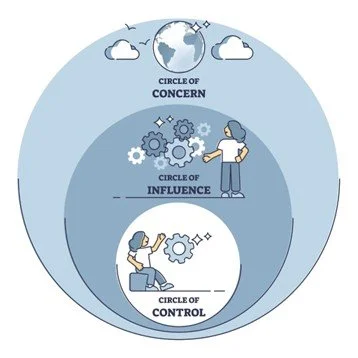
Draw a circle. Inside, write what you can control: your words, your breaks, and your responses. Outside, write what you cannot: other people's moods, their reactions, and the final results of their choices.
3. Pause before responding
Before jumping in, ask yourself:
"Is this my problem to solve, or am I running on 'if I can, I should'?"
"Can this person handle this on their own?"
4. "Hold Space" instead of fixing
Try offering empathy instead of solutions. Saying, "That sounds incredibly hard; I am here for you," is often more powerful than telling someone what they should do.
How Therapy can help
If letting go triggers intense anxiety, therapy can provide the support needed to heal. Through therapy, you can:
Explore the origins: Identify the childhood experiences that taught you to over-function.
Challenge the Inner Critic: Address the guilt that arises when you put your own needs first.
Develop healthy boundaries: Learn to say "no" without the crushing weight of guilt.
Build self-worth: Realise that your value lies in who you are, not just what you can do for others.